A few weeks ago I said I thought the NDC plateau was about servicing rather than standards. Here is the reasoning. It turned out a bit wider than I first thought.
Booking on NDC mostly works. What happens after the booking is where it gets hard. I see four places.
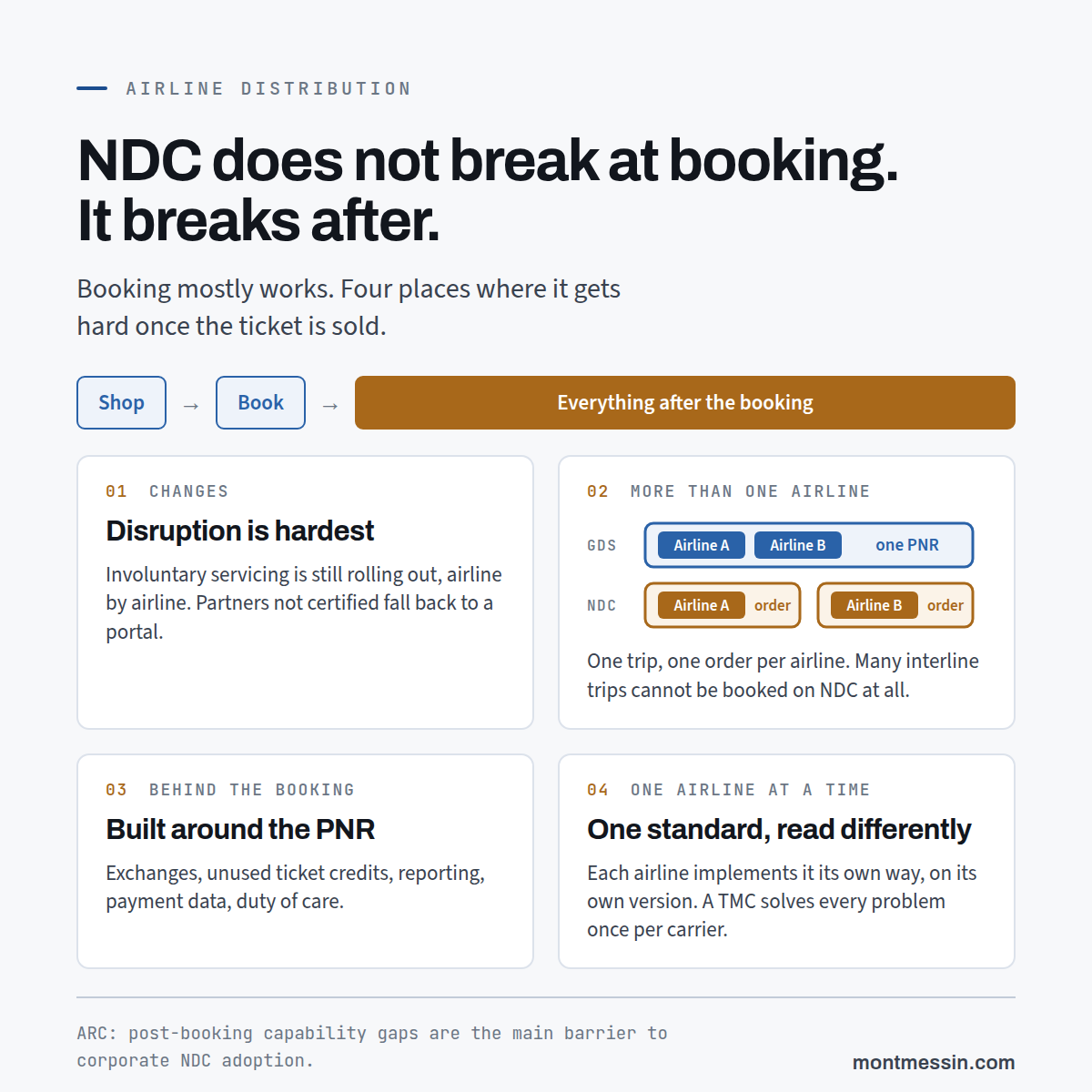
Changes and disruption. One European group has spent something like €10m over two years on NDC servicing alone, and only put involuntary servicing live in May 2025. Partners who are not certified on that version still fall back to an agent portal. That is one of the better resourced cases in the industry, with a long head start. And it is still hard. In practice, during irregular operations an agent checks the aggregator, then checks the GDS, then picks up the phone.
Trips with more than one airline. In the GDS, one PNR holds the whole trip, whatever the carriers, and every schedule change lands in that one record. With NDC, each airline holds its own order. Many mixed-carrier and interline trips cannot be booked through NDC at all. Where they can, one disruption can arrive as several separate order change notifications for what the passenger sees as one journey. The joint work that exists is still narrow. Lufthansa Group and Air Canada started NDC interlining in July 2025, for selected Air Canada flights combined with a Lufthansa Group flight, with Lufthansa Group issuing the ticket.
Everything behind the booking. Exchanges, unused ticket credits, reporting, payment data, duty of care. These tools were built around the PNR. A large TMC said last year that unused ticket credits on NDC are often still a manual process, and that many booking tools cannot handle online exchanges for NDC bookings. Another said that when a traveller changes a booking on the airline website, the agency sometimes cannot see who changed it or how it was paid.
One airline at a time. There is a standard, but each airline reads it and implements it a bit differently, often on its own version. A TMC does not solve each of these problems once. It solves them once per carrier.
ARC's chief executive has said post-booking capability gaps are the main barrier to corporate NDC adoption. Not price, not content.
That is more or less my explanation for the flat line. It is difficult to sell a richer offer through a channel that struggles to fix it on a Tuesday afternoon, when an aircraft goes tech and people have to be reaccommodated across two carriers.
Offer construction got most of the investment over the last decade. What happens after the booking got what was left. The share number may just be that, showing up in the data.
Chapter 8 of Airline Distribution Explained is where I set this out properly, and it ends with a scorecard rather than an argument, including the things that have not worked. The thirty item audit the book closes with is free on its own, as a fillable PDF: the two diagnostics.
I would be glad to be wrong here. If you work in corporate travel, what does your process on an NDC ticket look like when the trip changes?
What I left out
The 10 million euro figure is one European group over two years, reported in a single trade piece. I am using it as an illustration of scale, not as a benchmark.
The TMC comments are from early 2025. Some of these gaps will have narrowed since, and they differ a lot by airline and by booking tool.
My explanation for the flat line is a reading rather than a measurement. Nobody publishes a breakdown of why NDC share stopped moving, so I am inferring cause from a few data points and a lot of conversations. The carrier behind the €10m figure is named in the source. I have left it out here.
Sources
- Around €10m over two years on NDC servicing, involuntary servicing deployed May 2025, uncertified partners falling back to an agent portal, and one disruption producing several order change notifications: Business Travel Executive, 21 October 2025
- Mixed-carrier and interline bookings not yet supported, unused ticket credits often manual, booking tools without NDC exchanges, and changes made on airline websites the agency cannot see: Business Travel Executive, TMCs Take On NDC, 18 February 2025
- Lufthansa Group and Air Canada NDC interlining: Lufthansa Group, July 2025
- Post-booking capability gaps as the main barrier to corporate NDC adoption: ARC chief executive Lauri Reishus