Something I keep coming back to, and it is most of what the third book is about. It is published today.
ANA ran its domestic and its international passenger systems as two separate systems from 1988 until this year. It announced the integration in February 2023 and cut over between 19 May and 9 June 2026, airport by airport.
Thirty-eight years on one architecture. Three years from announcement to cutover.
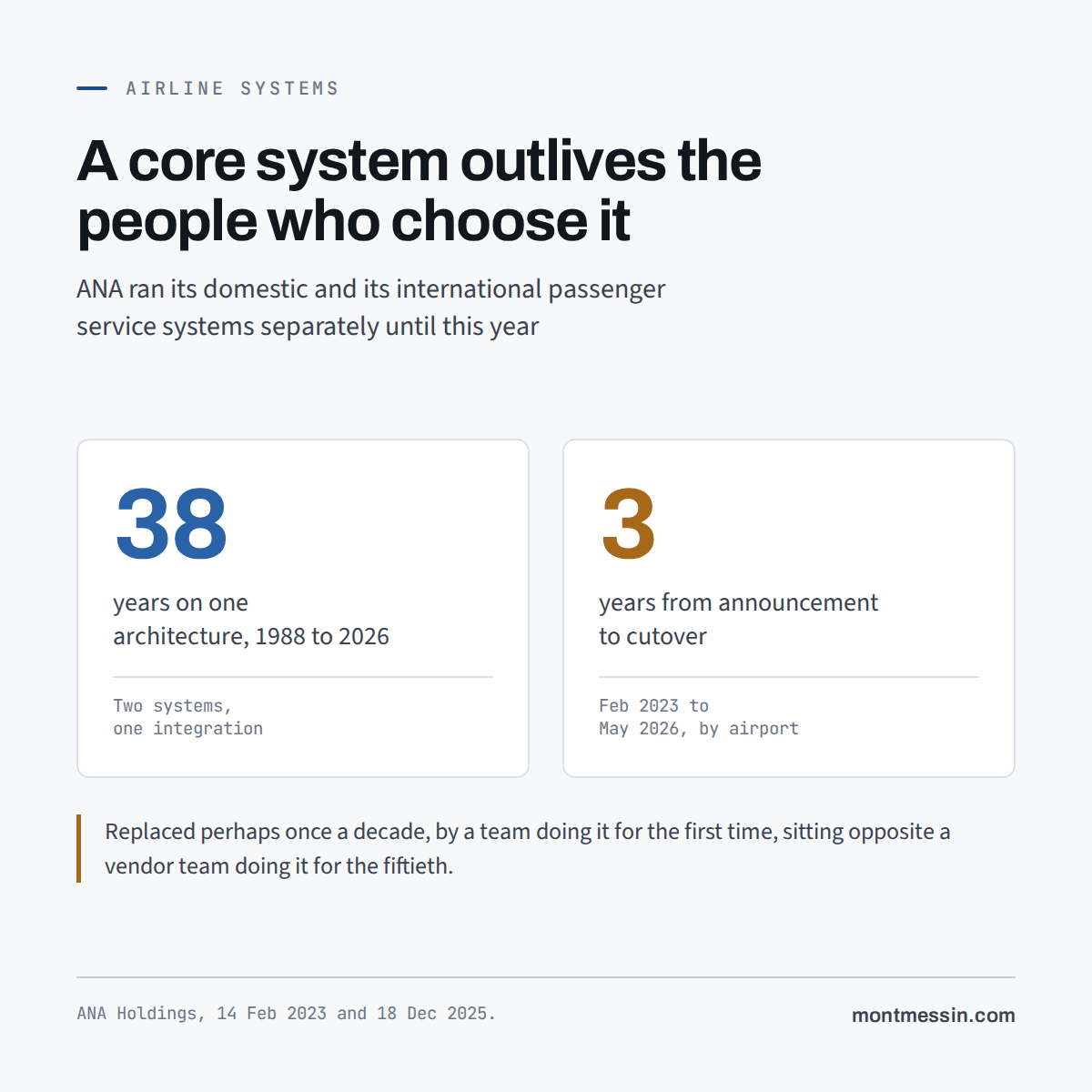
That is the shape of this decision. A passenger service system holds the booking, the inventory, the ticket and the customer record, and more or less everything else in the airline reads from it. So it gets replaced perhaps once a decade, by a team doing it for the first time, sitting opposite a vendor team doing it for the fiftieth.
The migrations went well, which surprised me
I went looking for this year's disasters and did not find any.
Alaska moved Hawaiian onto its system on 22 April, after eighteen months of work and five full dress rehearsals, including simulations with real passengers checking in and clearing security. Millions of bookings moved. The fifth rehearsal ran with no medium or high issues, and I found no reports of real disruption at the cutover.
United took its reservation system offline for a few hours on 4 February for a planned upgrade, and removed roughly 600 departures from the schedule months in advance so that nothing was flying while it happened.
Both of those produced one press release each. The famous failures, which are all a decade or more old, produced years of citations. I think that asymmetry is why the industry believes migrations usually fail. The visible record is selection bias.
What a success still costs
ANA's own passenger notices are the honest version. During the transition, seat selection was unavailable in the window from 48 to 24 hours before departure at airports not yet migrated. Upgrade waitlisting was suspended. And a booking for a flight before 19 May could not be changed to a flight on or after it. You had to refund and rebook.
That is a successful migration.
The pattern I did not expect
Almost every modern retailing announcement I read from 2025 and 2026 is additive rather than a replacement. One carrier signs for a new retailing platform and explicitly keeps its existing passenger service system. Another puts an order management layer on top of the system it already runs. A third platform is sold as system agnostic by design, so it sits beside whatever the airline has.
Meanwhile a survey published in May 2026 found that nearly 70% of carriers still have no order management system at all, and that over 41% of the airline employees surveyed rated their own carrier's retailing as poor or very poor.
My reading is that the industry has found a way to modernise the shop window without touching the core, precisely because touching the core is the decision nobody wants to make twice.
I do not have a clean view on whether that is prudence or deferral. It looks like prudence when you read the ANA transition notices and like deferral when you read the survey. What would you look at to tell the two apart?
What I left out
I went looking for this year's migration disasters and did not find any. That is not the same as there being none. A migration that goes badly for one airline and gets fixed quietly does not produce a press release either, so my own selection bias argument cuts both ways.
The retailing survey is 213 responses fielded between January and March 2026. That is a small base for a claim about the whole industry, and the people who answer a retailing survey are not a neutral sample of the people who work in it.
Added after publication, 12 November 2026
I asked what to look at to tell prudence from deferral. Three answers from the comments are worth keeping.
The first is a test: check who owns the order record. I read it this way. If the new order layer holds the record and the old system reads from it, the core is being replaced step by step. If the old system still holds the record, the new layer is a shop window.
The second is about people. A reader who worked on an airline's own system before the vendor era made this point. Airlines once had teams who knew their whole IT estate. When the core moved to a vendor, that knowledge left with them. No vendor holds the full picture of one airline either. So each new layer gets added without anyone owning the whole.
The third is that nothing proven exists yet to replace the core. Pricing and revenue management still rest on booking classes. There are theories, but none has been built. If that is right, adding around the core is less a choice than the only option available today.
Sources
- ANA to integrate domestic and international passenger service systems, ANA Holdings, 14 February 2023: systems operated separately since 1988; integration onto a single platform across FY2025 to FY2026
- Passenger service system integration schedule, ANA Holdings, 18 December 2025: cutover from 19 May 2026, sequenced by airport
- Alaska Airlines and Hawaiian Airlines transition to a shared passenger service system, Alaska Airlines, 22 April 2026
- Inside the post-merger IT overhaul at Alaska Airlines, CIO, 7 August 2026: eighteen months, five full mock cutovers including simulations with real guests, millions of bookings migrated
- United to disable app for system upgrade, Travel Weekly, 2 February 2026, and CBS News, 2 February 2026: system offline 2:30 to 6:00 a.m. ET on 4 February 2026, roughly 600 flights cancelled months in advance
- The state of airline retailing 2026, PhocusWire, 13 May 2026: nearly 70% of carriers without an order management system; over 41% of surveyed airline employees rating their own retailing as poor or very poor. 213 responses, fielded January to March 2026
Not used: the GAO count of 34 airline IT outages, with about 85% causing delays or cancellations, is real but it is GAO report 19-514, published June 2019 and covering 2015 to 2017. It circulates without its date. There is no current equivalent, because GAO itself noted that no government data source exists.