I have been putting three numbers next to each other and the gap between them surprises me every time.
IATA, this August. 17% of travellers who tried to buy an ancillary gave up because the payment failed and no other method was offered.
Outpayce asked 4,500 travellers. 56% had an ancillary fee waived at the airport because acceptance failed at the point of sale. 45% said they would buy more if their preferred method was available. The same survey puts average spend on airline and airport services at around €263 a trip, so that 45% sits on top of a real number rather than a stated preference.
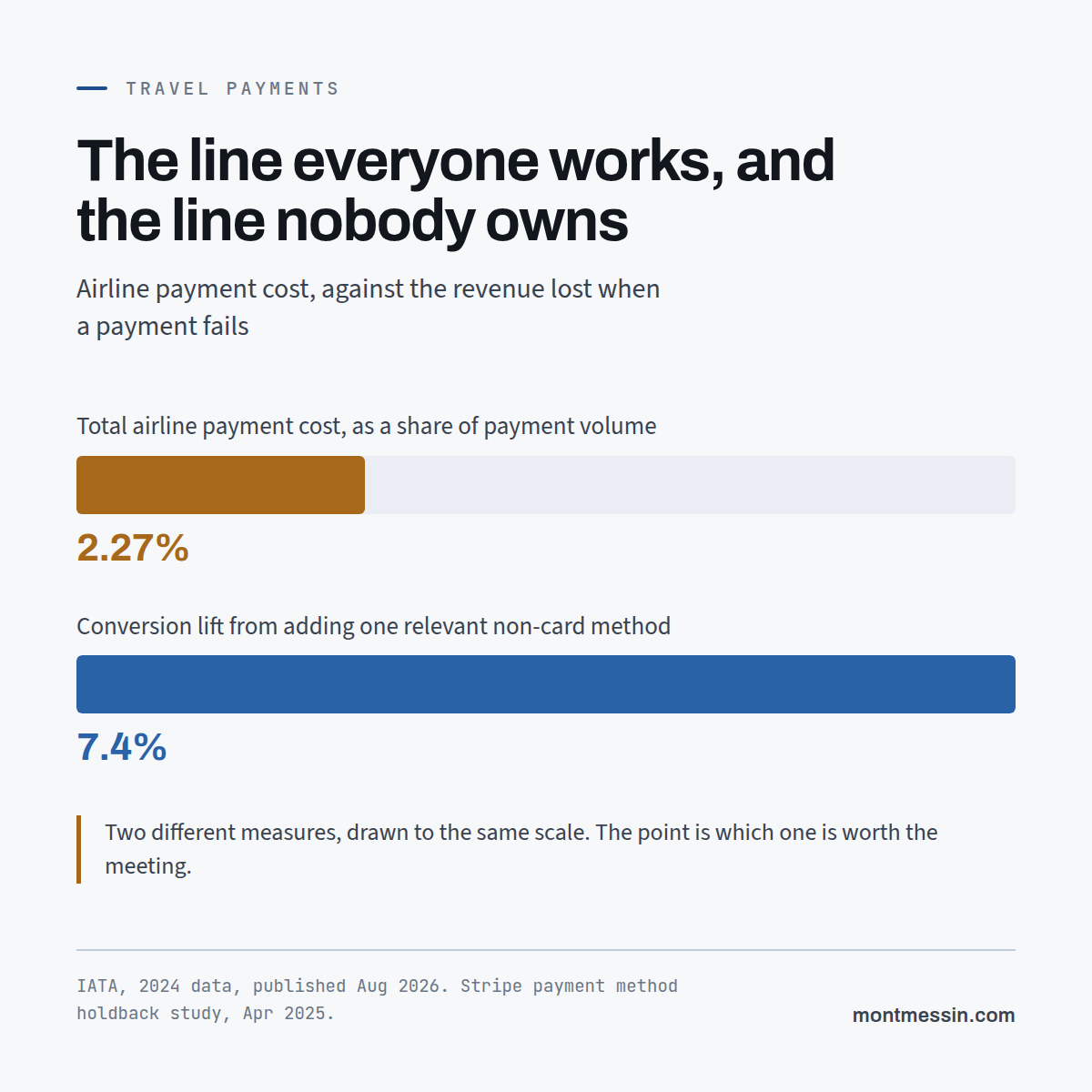
Stripe ran a holdback test across more than fifty payment methods. Adding one relevant non-card method gave 12% more revenue and 7.4% better conversion.
Then the cost side. Total airline payment cost is around 2.27% of payment volume, on IATA and Edgar Dunn's own figures published this August.
So a seven percent conversion improvement is roughly three times the whole cost line.
I understand why the cost side gets the attention. It has an owner and a target. Declined revenue does not really have either, and the traveller who could not pay does not complain. They just leave.
The question I would take into a payments review is a simple one, and it is usually harder to answer than it sounds. What is our authorisation rate, by market and by method, and what does a traveller actually see when it fails?
If nobody in the room knows, that is probably worth an afternoon.
What I left out
The three numbers do not come from the same place and I have stacked them anyway. IATA's 17% is from an opinion piece. Outpayce surveyed 4,500 consumers in late 2024. Stripe's test ran across its own merchant base, which is largely not airlines.
The comparison at the end is looser than it looks. 7.4% is a conversion improvement and 2.27% is a cost as a share of payment volume. Those are not the same denominator. The order of magnitude holds. The precision does not, and I would not put that ratio into a business case without redoing it on your own numbers.
One more thing about that 2.27%. It is $22.2bn of cost over $977bn of volume, both from IATA. But $977bn is the same volume base the 2019 study used, and payment volume did not stand still between 2019 and 2024. So my own reading is that the cost was refreshed and the volume carried over. That does not make the figure useless. It does mean it is less new than it looks.
Sources
- 17% of travellers abandoned an ancillary purchase because the payment failed and no alternative was offered: IATA, 3 August 2026
- 56% had an ancillary fee waived at the airport because acceptance failed, 45% would buy more with their preferred method, average spend of €263 a trip: Outpayce survey of 4,500 travellers, Q4 2024
- Adding one relevant non-card method delivered 12% more revenue and 7.4% better conversion: Stripe, 10 April 2025
- Total payment cost of 2.27% of volume, derived from IATA's 2024 figures of $22.2bn on $977bn