I think the Offers and Orders conversation changed in May, and not in the way most people expected.
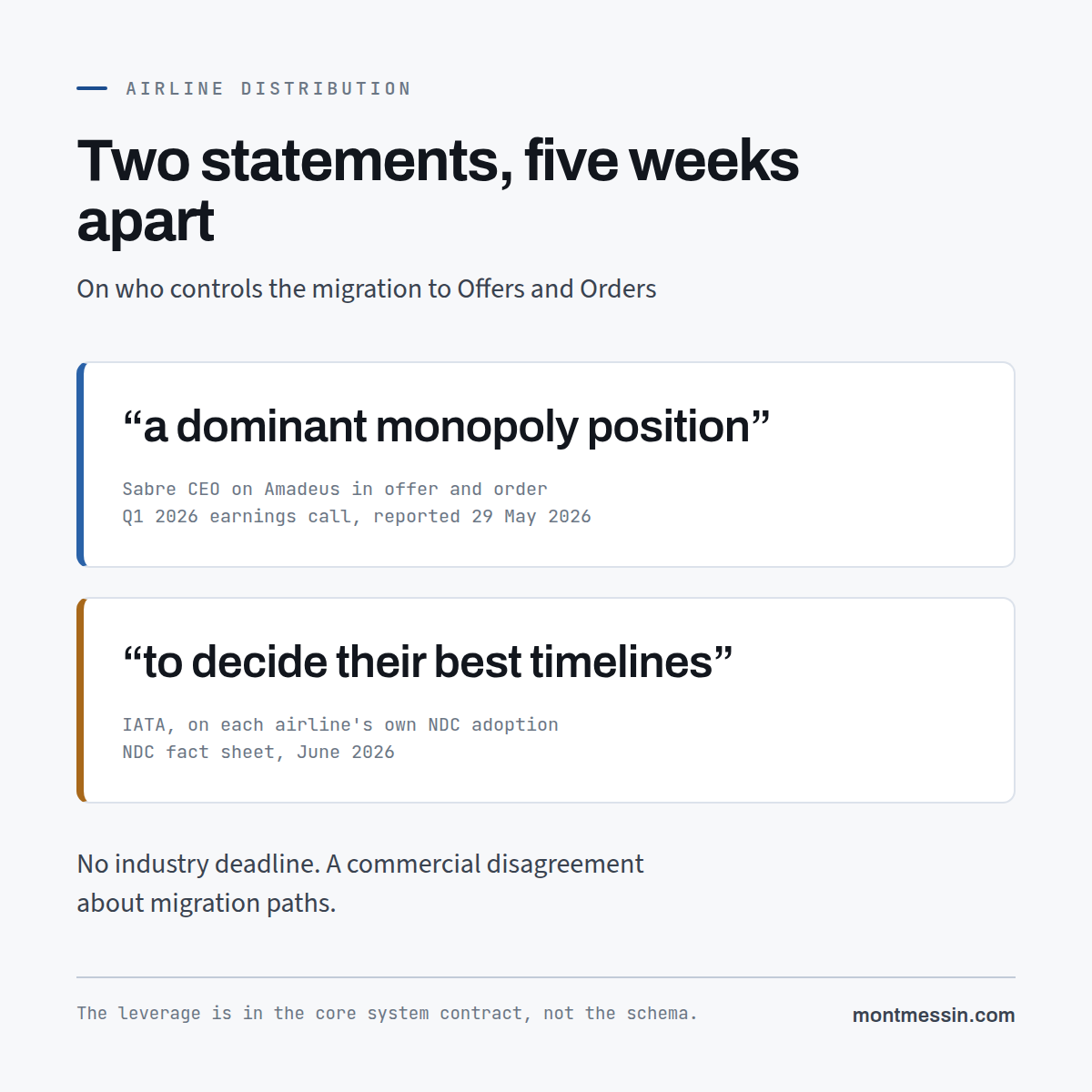
On his Q1 earnings call in May, Sabre's CEO said Amadeus holds a dominant monopoly position, and is making it very difficult for airlines to choose anybody but Amadeus for the new offer and order solutions. He said they are working on approaches from a regulatory and a legal standpoint.
Amadeus answered by describing itself as an integrated platform. It did not address the lock-in point directly.
Now put that next to IATA's own fact sheets from June. They say adoption is voluntary, that there are no mandated targets, and that each airline decides its own timeline. The retailing goal is stated as 100% offers and orders, with no year attached to it.
So there is no industry deadline. What there is, is a commercial disagreement about migration paths.
That changes where I would put my attention. Less on the schema, more on the core system contract. Three things in particular.
What you can extract if you leave, in what format, and at what cost. Whether you can put another vendor's offer engine in front of your PSS without a commercial penalty. And what running offer and order at volume actually costs you in year five.
If a core system contract is coming up for renewal in the next eighteen months, I would look hard at those clauses before I looked at the NDC roadmap. The GDS model and ONE Order each get a chapter in Airline Distribution Explained, written around who holds what rather than around the standard. I could be wrong on that. If you see it differently, I would like to know why.
What I left out
The words above come from the earnings call as reported on 7 May, not from the transcript, so the quotation is a reporter's and not mine. It is also worth holding on to who is speaking. A direct competitor calling a rival dominant is an interested party. That does not make the claim wrong, but it is not neutral testimony either.
I also left the year 2030 out of the post, and it is the number most people reach for when this comes up. I left it out because I could not make it mean what it is usually used to mean. As far as I can tell it comes from reporting in December 2022, where IATA had 2030 in its sights for the capabilities and the standards to be ready, for airlines that wish to adopt them. That is a date for the toolkit being finished. It is not a date by which an airline has to move. IATA's own transition roadmap from November 2024 says timelines vary by airline size, business model and region. So I preferred to leave the number out rather than repeat it and add to the confusion.
Added after publication, 24 September 2026
Cengiz İpek made a point this week that I had not thought about properly. He was writing about the map rather than the territory: what an AI agent can see of an airline, as against what the airline has actually built. From the agent’s side, he argues, a missing capability and a missing representation look identical. Both come back as nothing to call.
I think he is right, and it adds a fourth question to the three above. From inside an airline you can usually tell the two apart, and the difference is the price. Exposing something the core system already does is weeks of work. Building servicing that was never there is years. Same symptom, very different conversation with a CFO, and that is where roadmaps quietly break.
Sources
- Sabre's CEO on Amadeus holding a dominant monopoly position in offer and order, Q1 2026 earnings call, reported 7 May 2026: Skift, and the later trade write-up: Travel Distribution News
- Timelines vary by airline size, business model and region: IATA transition roadmap to 100% Offers and Orders, November 2024
- Where the 2030 number comes from, December 2022: PhocusWire
- Adoption is voluntary, no mandated targets, each airline decides its own timeline: IATA NDC fact sheet, June 2026 and the ONE Order fact sheet of the same date
- 100% offers and orders stated with no target year: IATA airline retailing programme