This is a composite example from my third book, Airline Systems Explained, which came out on 10 November. It is not one airline's project. I built it from how this kind of change usually goes.
A mid-sized airline, four million passengers a year, decides to include a checked bag in its flexible economy fare on some routes. Commercially, it is one paragraph. The product manager expects two weeks.
Then the request starts to travel.
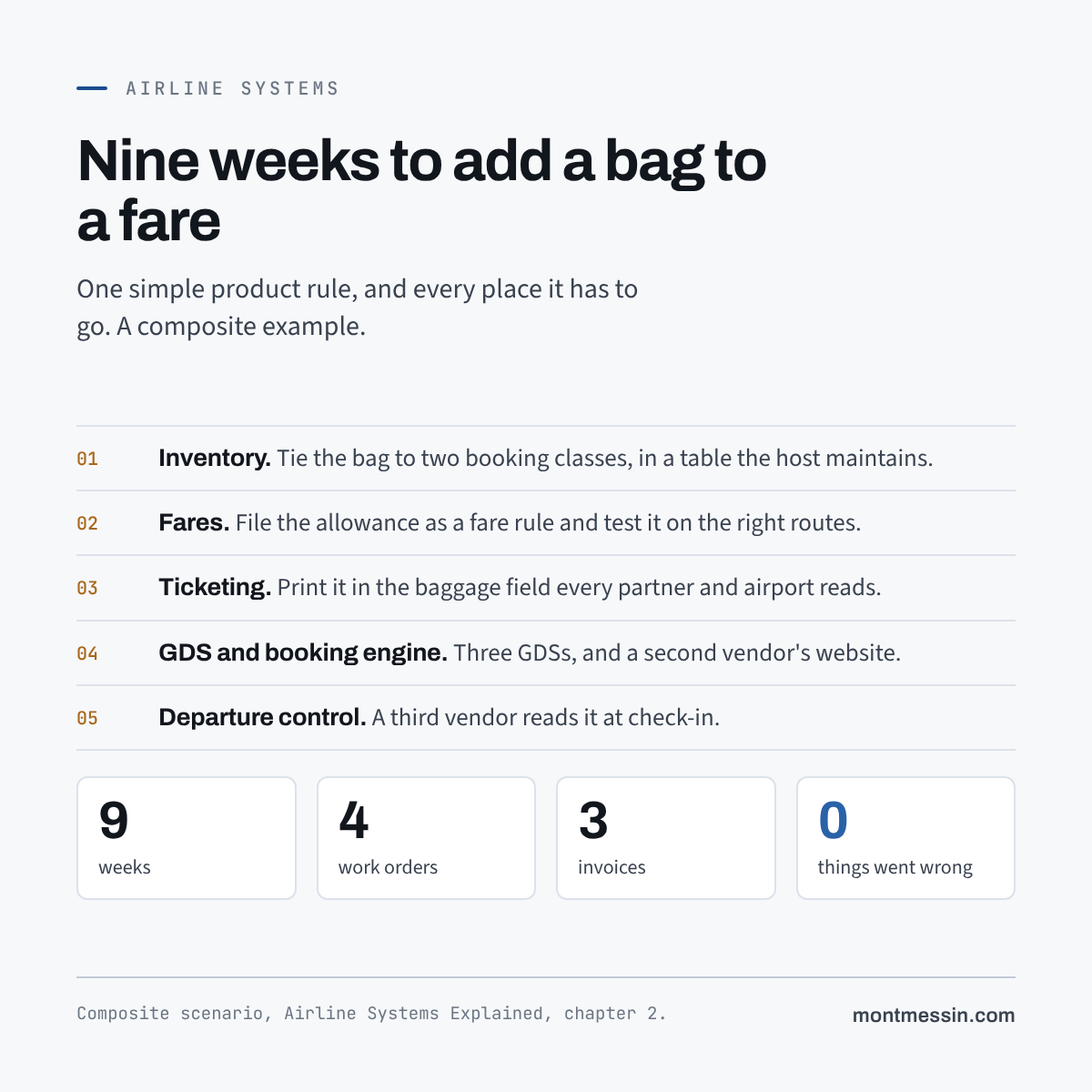
First to inventory. The fare is sold in two booking classes, and the bag must be tied to those two classes only, in a table the host system maintains. That is a work order.
Then to fares. The bag allowance is a fare rule. It is filed through the central fare utility, in a format the pricing engine reads, and it has to be tested so it shows on the right routes only.
Then to ticketing. The allowance has to print in the baggage field of the ticket, which every partner and every airport reads. On trips shared with a partner airline, someone has to check whose allowance applies.
Then to the GDS feed. Agents will sell this fare, so the rule has to reach three GDSs correctly. The airline's own booking engine, from a second vendor, has to show it too.
Last, to departure control, from a third vendor. The check-in screen has to read the allowance from the ticket, so an agent at an outstation does not charge for a bag that was included.
Nine weeks. Four work orders. Three invoices.
And nothing went wrong. Every step was needed, and every vendor did its job.
That is the part I find most useful. In a ticket-based core, a product rule is not a setting. It is a change to several records that a dozen parties read. My own feeling is that commercial teams often plan as if it were a setting, and then the launch date moves.
In my experience the airlines that handle this well are not faster at each step. They know the order of the steps before they promise a date.
How long would a change like this take in your airline?
What I left out
This is a composite scenario, not a measured project. The nine weeks show the order and the dependencies, not a benchmark. Some airlines do this faster, in particular on a newer offer and order platform, where a new product is meant to be configuration rather than a work order. Others take much longer, for example when a partner airline also has to change something on its side.
Added after publication, 5 November 2026
The comments added three things I had not put in the piece.
The first is that nine weeks is the figure with four vendors in the chain. Someone with a decade in revenue management pointed out that an airline which files its own fares and maps its own inventory removes most of the waiting, because most of the time went to someone else's queue rather than to the work. The variable is how much of each step the airline controls, not the number of steps. In my experience that control is also the first thing to go when the systems are outsourced, and it is rarely written into the contract.
The second is what happens after go-live. Several people asked how an airline knows the bag is still there once the booking is changed, reissued or partly refunded. The honest answer is that most do not check. The project tests the happy path and closes. The only thing I have seen work is a few test bookings kept alive after launch and pushed through every change, with someone owning the monthly check.
The third is that the same pattern exists in hotels: one new rate plan in the revenue system, then a mapping in the channel manager, a load in every OTA and GDS, and a change in the booking engine. Knowing the sequence before promising a date is the real distribution skill, in both industries.
Source
- Airline Systems Explained, chapter 2, The Passenger Service System: the composite scenario "one simple rule". Published 10 November 2026. Kindle, paperback and hardcover