Merchant of record usually gets discussed as a technical setting. Somebody picks it in an integration document and it never comes up again.
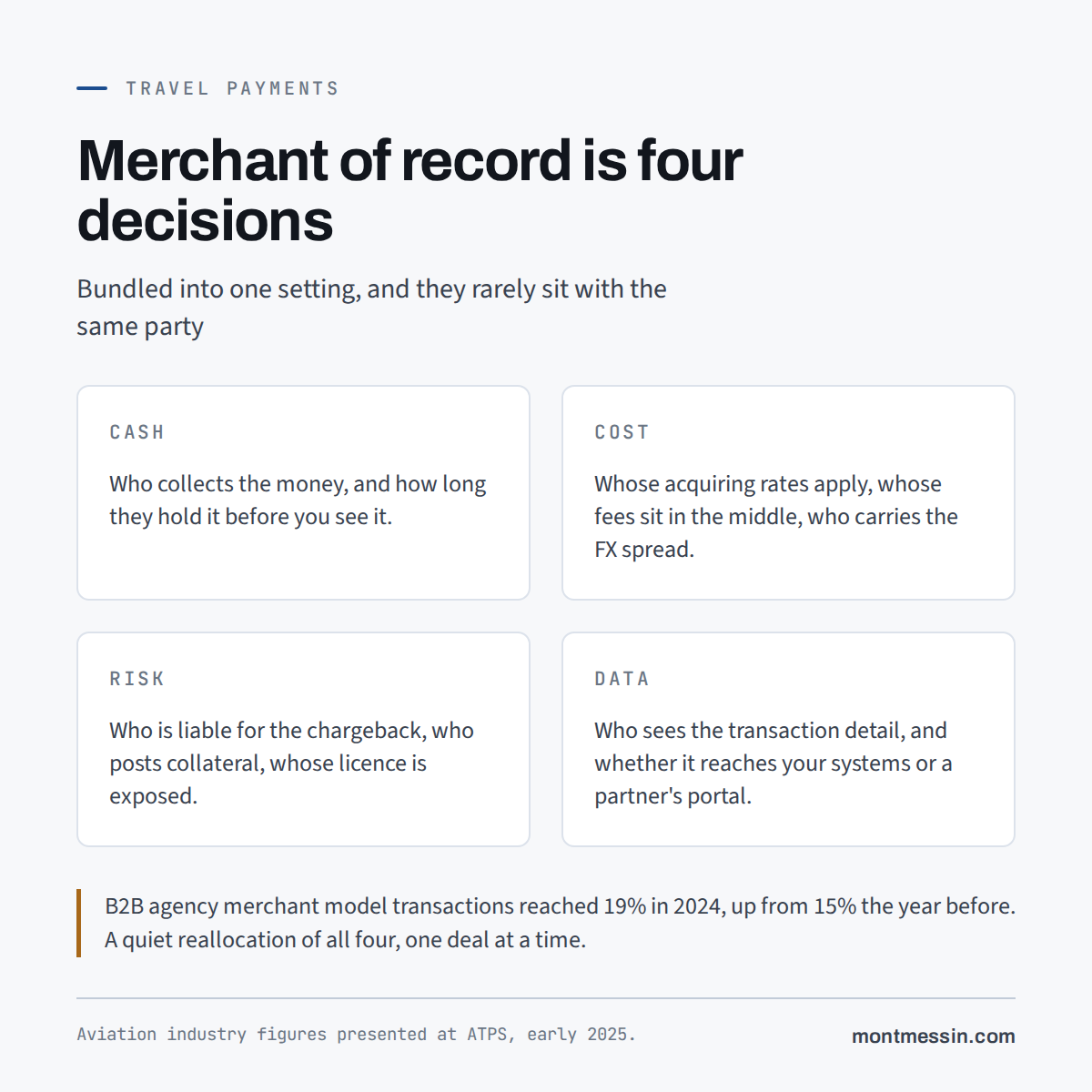
It is four separate decisions bundled into one, and they do not always point the same way.
Cash. Who collects the money, and how long they hold it before you see it. Settlement timing is working capital, and in travel the gap between sale and departure makes that gap larger than in almost any other sector.
Cost. Whose acquiring rates apply, whose fees sit in the middle, and who carries the FX spread. A rate you did not negotiate is still a rate you pay.
Risk. Who is liable for the chargeback, who posts collateral, and whose licence is exposed if something goes wrong. This is the one that surprises people, because it does not follow the money automatically.
Data. Who sees the transaction detail, and whether it reaches your own systems or only a partner's portal. If you cannot see it, you cannot reconcile it, and you cannot argue about it later.
In travel these four rarely sit with the same party by design. They end up wherever the last commercial negotiation left them, and then nobody goes back to check. I have seen arrangements where cash and data sat with one party, cost with another, and nobody in the room could say out loud where the risk had landed.
It is also moving. Mastercard figures presented at an industry summit in early 2025 put B2B payment models at 19% of aviation transactions in 2024, up from 15% the year before. That is a quiet reallocation of all four decisions, one deal at a time, and it is happening faster than most payment policies get reviewed.
The test I would use is not complicated. Take one channel in one market and write the four answers on a single line. If any of them takes more than a day to establish, that is the finding.
Most travel companies I meet can tell me their payment cost to two decimal places. Few can tell me, channel by channel, who is actually on the hook.
What I left out
The 19% figure comes from a conference presentation reported in the trade press rather than from a published dataset, so I would trust the direction more than the number.
The four decisions framing is mine. It is a way of organising the question, not an industry model, and someone sitting on the acquiring side rather than the airline side might well split it differently.
Sources
- ATPS25: trend towards travel agency merchant payment model hailed as a win-win, Aviation Business News, February 2025, reporting Mastercard at the ATPS25 B2B summit: B2B payment models at 19% of aviation transactions in 2024, up from 15% in 2023
- EU Interchange Fee Regulation (EU) 2015/751: consumer interchange caps of 0.2% on debit and 0.3% on credit, with commercial cards outside the cap