In May, Spirit Airlines stopped flying, during its second bankruptcy in two years. Around 60,000 passengers a day lost their flights, and the US Transportation Secretary told them to consider credit card chargebacks.
I want to write about something that gets much less attention than fraud, and that I think is a bigger exposure.
When an airline stops flying, its chargeback rate goes from under 1% to somewhere between 20% and 40% within weeks. Every unflown ticket turns into a dispute at once.
The exposure is not this month's processing volume. It is every ticket already sold for travel that has not happened yet. Estimates put card paid, forward sold airline inventory at $95bn to $115bn at any point in the seasonal cycle.
Then look at the protection. For higher-risk airlines, holdback is commonly 5% to 15% of monthly settled volume. A rolling reserve, even when fully built up, typically reaches one to two months of settled volume. Actual exposure runs two to six months of forward inventory, and it peaks exactly when a carrier under pressure is selling hardest into the next season.
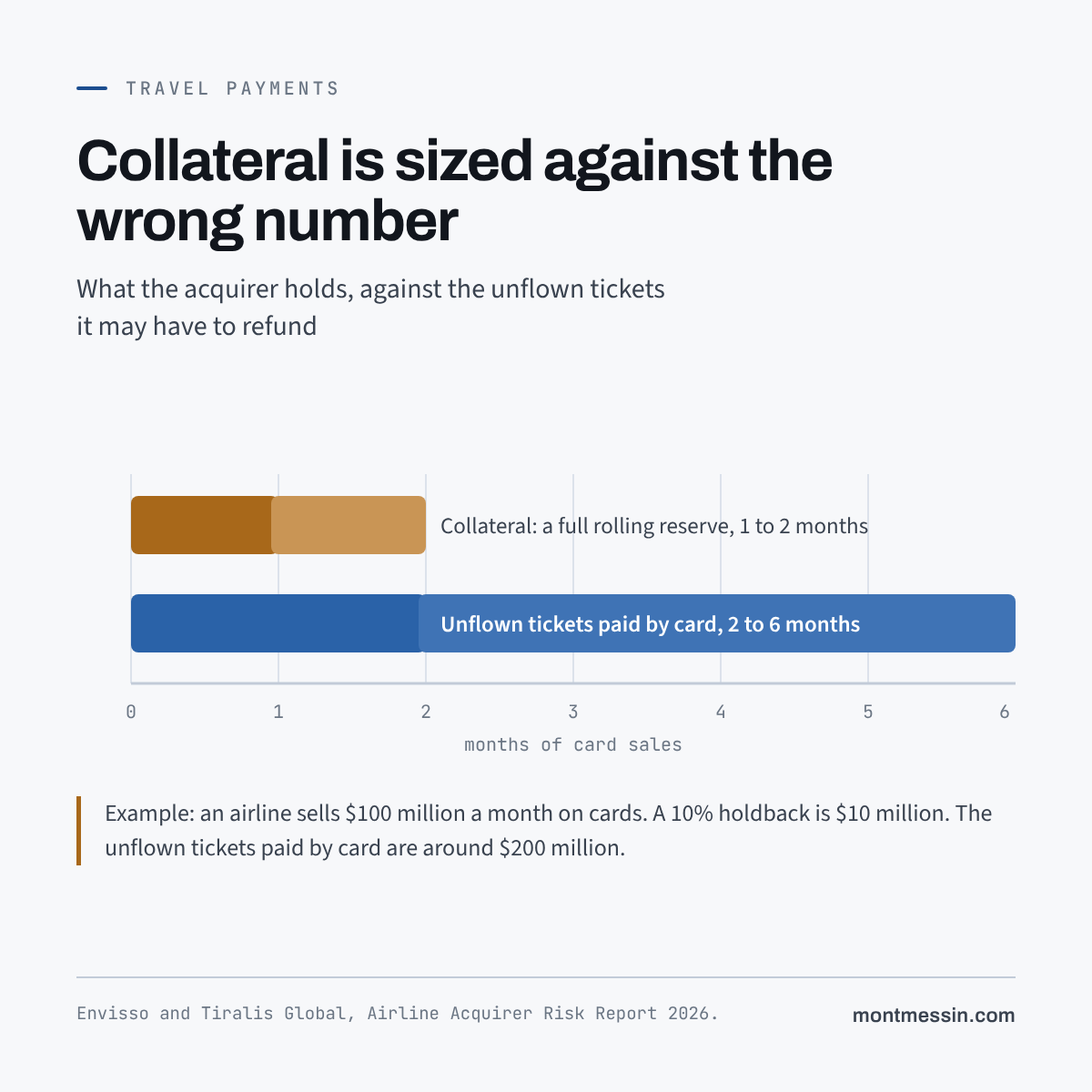
So two numbers matter here. Today the collateral is sized on the first one: how much the airline processes on cards each month. The real risk is the second one: the value of tickets already paid by card for flights that have not happened yet. Airlines report it as the forward sales liability, or air traffic liability.
A simple example. An airline sells $100 million on cards each month, and people book around two months ahead. A 10% holdback is $10 million. The unflown tickets paid by card are around $200 million. If the airline stops flying, it is the $200 million that can come back as chargebacks.
This is why I think the second number is the right one to size against. It also moves with the season, so it needs to be watched every month, not once a year.
This is not new. In 2008 Frontier Airlines filed for Chapter 11 a few days after its card processor asked to hold back 50% of its card sales at once, and 100% a few weeks later. Frontier told the court it could not lose access to almost half of its revenue. Acquirers know the risk well. A Worldpay article on airline payment risk says it plainly: when an airline cannot fly passengers who have already paid, the acquirer faces significant exposure through chargebacks.
It is also a large number in a single failure. When Monarch stopped flying in 2017, more than 300,000 future bookings were lost on the same day.
Some context on how often this comes up. 35 scheduled passenger airlines stopped operating between 2019 and 2026, and around 63% of those trace back to structural weakness rather than a single shock. The three main rating agencies rate just 34 airline entities, so for most of the market there is no external signal at all.
If you sit on the acquiring side, the question I would ask is not what this airline processes but what it owes, and when it flies.
If you sit on the airline side, this is a large part of why your merchant terms look the way they do. In my experience there is more room to move than treasury teams assume, if you can show the shape and the seasonality of your forward book rather than argue about processing volume.
The market figures come from the Envisso Airline Acquirer Risk Report 2026, which is worth reading if this is your area. The Frontier case, the Worldpay article and the UK Airline Insolvency Review show the same problem from other sides.
What I left out
The market wide figures still come from one report, produced by a company that sells cover for airline acquirer risk. The other sources confirm the mechanism: processors do raise holdbacks on airlines under pressure, and acquirers do carry the unflown tickets. They do not confirm the size of the gap. I have not found an independent series measuring the same things, and that absence is part of the story.
Added after publication, 29 October 2026
Two points from the comments were worth adding.
The first was an idea: pay on arrival. The customer's money is held in escrow and released only when the last flight lands. It would remove most of the acquirer's exposure. But many airlines fund their operations with the cash from advance sales, so for them it would be a large working capital change. My feeling is it would hurt most the airlines already under pressure. A variant came up too: a card issuer offering it as a service to its best customers. In a way the chargeback right already does part of this.
The second came from the agency side. When an airline stops flying, the agency gets the calls first: the rebooking, the refunds, the customers who want answers. And when the agency paid with its own card, part of the exposure sits with the agency too.
Sources
All figures from the Envisso Airline Acquirer Risk Report 2026:
- Chargeback rate moving from under 1% to between 20% and 40% within weeks of a carrier ceasing operations
- $95bn to $115bn of card paid, forward sold airline inventory at any point in the seasonal cycle
- Holdback commonly 5% to 15% of monthly settled volume for higher-risk airlines, rolling reserves reaching a balance of one to two months of settled volume, exposure spanning two to six months of forward inventory
- 35 scheduled passenger airline failures between 2019 and 2026, around 63% traced to structural weakness
- The three main rating agencies rating just 34 airline entities
Other sources:
- Frontier Airlines and First Data, 2008: Digital Transactions and Skift, 2020
- Acquirer exposure through chargebacks when an airline cannot fly passengers who have paid: Worldpay, Understanding airline payments risk
- Monarch, more than 300,000 future bookings lost in October 2017: UK Airline Insolvency Review, final report, March 2019
- Spirit Airlines ceasing operations on 2 May 2026, about 60,000 passengers a day affected, chargeback advice from the US Transportation Secretary: CNN via WRAL, May 2026