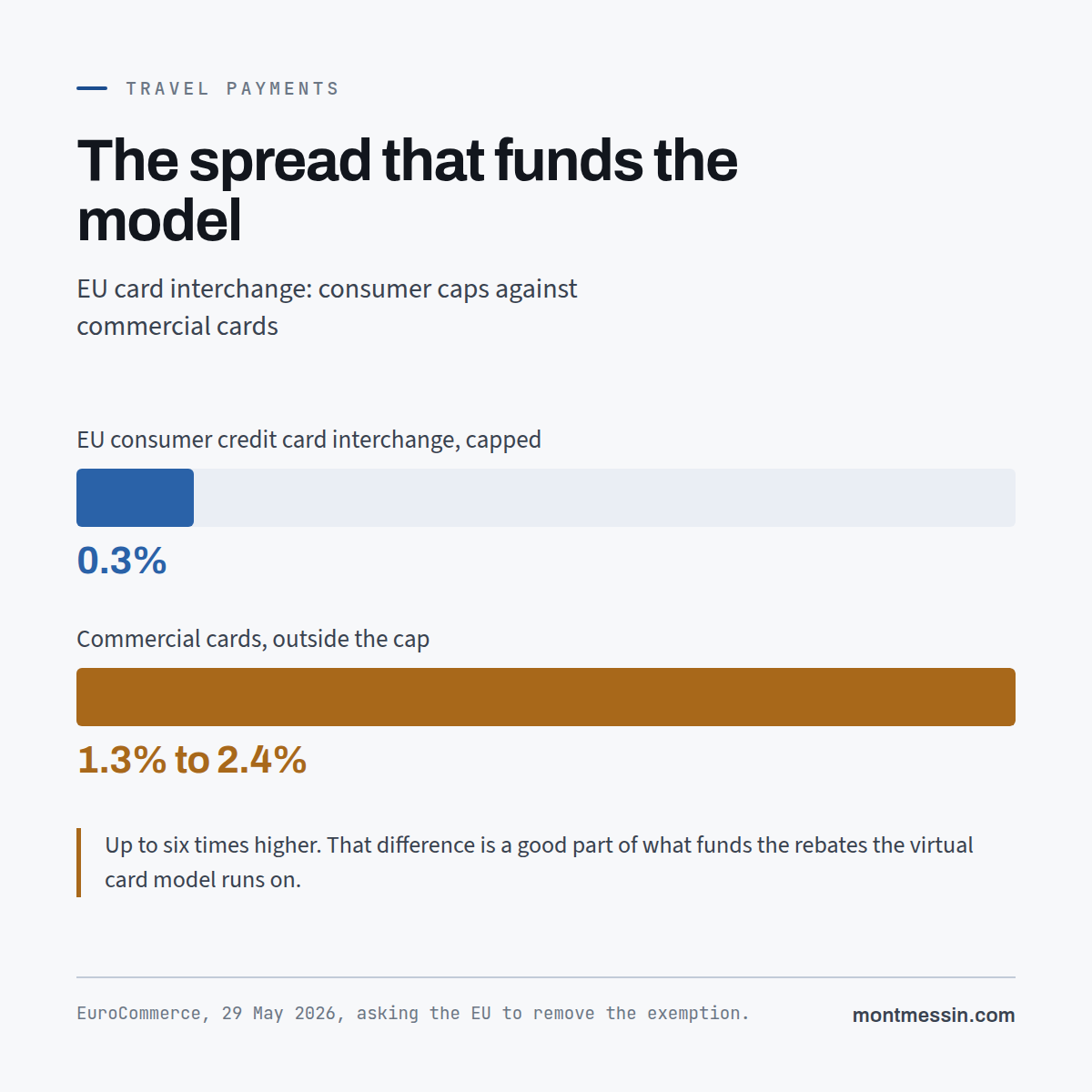
In the EU, consumer card interchange is capped at 0.2% on debit and 0.3% on credit. Commercial cards sit outside that cap, at roughly 1.3% to 2.4%. EuroCommerce puts it at up to six times higher.
That difference is a good part of what funds the rebates the virtual card model runs on. So a large part of the B2B payment economics in travel rests on a regulatory exemption, and that exemption is being challenged on both sides of the Atlantic.
This is the one I would most want a travel finance team to look at.
Two things happened this year.
In May, EuroCommerce asked the EU to bring commercial cards under the cap. They put European merchant overpayment at at least four billion euros in 2025, and gave payments between travel intermediaries and hotels or airlines as an example.
In June, a US court gave preliminary approval to the Visa and Mastercard settlement. The final hearing was held on 16 November and the ruling is pending. Around twelve million merchants would get the right to decline some commercial and premium credit cards, and to add surcharges or offer discounts.
Meanwhile virtual card payments are forecast to go from $5.2tn in 2025 to $17.4tn in 2029, driven mostly by B2B.
I am not predicting the exemption falls. These fights take years, and the last one took about a decade. But if rebate income is a real line in your business, three questions seem worth an afternoon.
How much of gross margin is rebate income, before netting anything off. What supplier settlement economics look like at consumer capped rates. And whether your supplier contracts let you change payment method without reopening commercial terms.
If the answer to the last one is no, that is where the exposure sits, and it is contractual rather than regulatory.
I have heard that renegotiation described more often than I have seen it done.
Has anyone here changed payment method with a supplier without reopening the commercial terms?
What I left out
I am describing a regulatory fight while it is happening, and I have read the merchant side's own submission rather than an independent assessment of it. The four billion euro overpayment figure is EuroCommerce's, produced by a party arguing for the exemption to be removed.
The interchange ranges are wide because commercial card rates vary by scheme, product and country, so a specific programme could sit outside them. And this is not to be mixed with the older $6.8tn-by-2026 forecast, which is from June 2021 and contradicts this series.
Sources
- EU consumer interchange capped at 0.2% on debit and 0.3% on credit, commercial cards at 1.3% to 2.4%, European merchant overpayment of at least EUR 4bn in 2025, and travel intermediary flows to hotels and airlines named as a driver: EuroCommerce, 29 May 2026
- US Visa and Mastercard settlement given preliminary approval 9 June 2026, final approval hearing 16 November 2026, around 12 million merchants gaining the right to decline commercial and premium credit cards: Payments Dive
- Virtual card payments from $5.2tn in 2025 to $17.4tn in 2029, driven mostly by B2B (Juniper Research, March 2025): Edgar Dunn, citing Juniper Research