A few things happened this year that made me more careful about the agentic travel conversation.
In March, OpenAI stepped back from checkout inside ChatGPT and went back to discovery, pushing transactions out to third party apps. Expedia and Booking shares went up that day.
In June, Mastercard launched Agent Pay for Machines with more than thirty partners. I looked through the announcement for travel use cases and did not find any.
In August, Google shipped agentic hotel booking in AI Mode with ten large partners. The detail is worth reading. The hotel or the OTA stays merchant of record, and Google says the AI does not book on its own.
Then last week, Amadeus and Anthropic. I read that one twice, because the coverage around it sounded like agentic booking. It is developer tooling. A toolkit for building against Amadeus content inside Claude Code, with a waitlist open, and a plugin for travel sellers that is proposed rather than available.
What I keep thinking about there is the context rather than the announcement. Amadeus had already closed its self-service developer portal, and it has not said how access or pricing to this compares, or whether an enterprise contract is needed. The open door shut and an AI-assisted one opened, with the commercial terms still blank.
And this week, Meta launched Muse, which looked like the exception. It uses Duffel to search and book real flights, and Duffel handles the changes and cancellations afterwards. That is a proper booking path, and Duffel is a real one: their own site says flights from more than three hundred airlines across NDC, GDS and low cost content.
So I signed up. I got a waiting list.
It is a closed test with invite codes, and as far as I can tell the United States only for now. Which makes the exception another waiting list, the same as the Amadeus announcement four paragraphs ago.
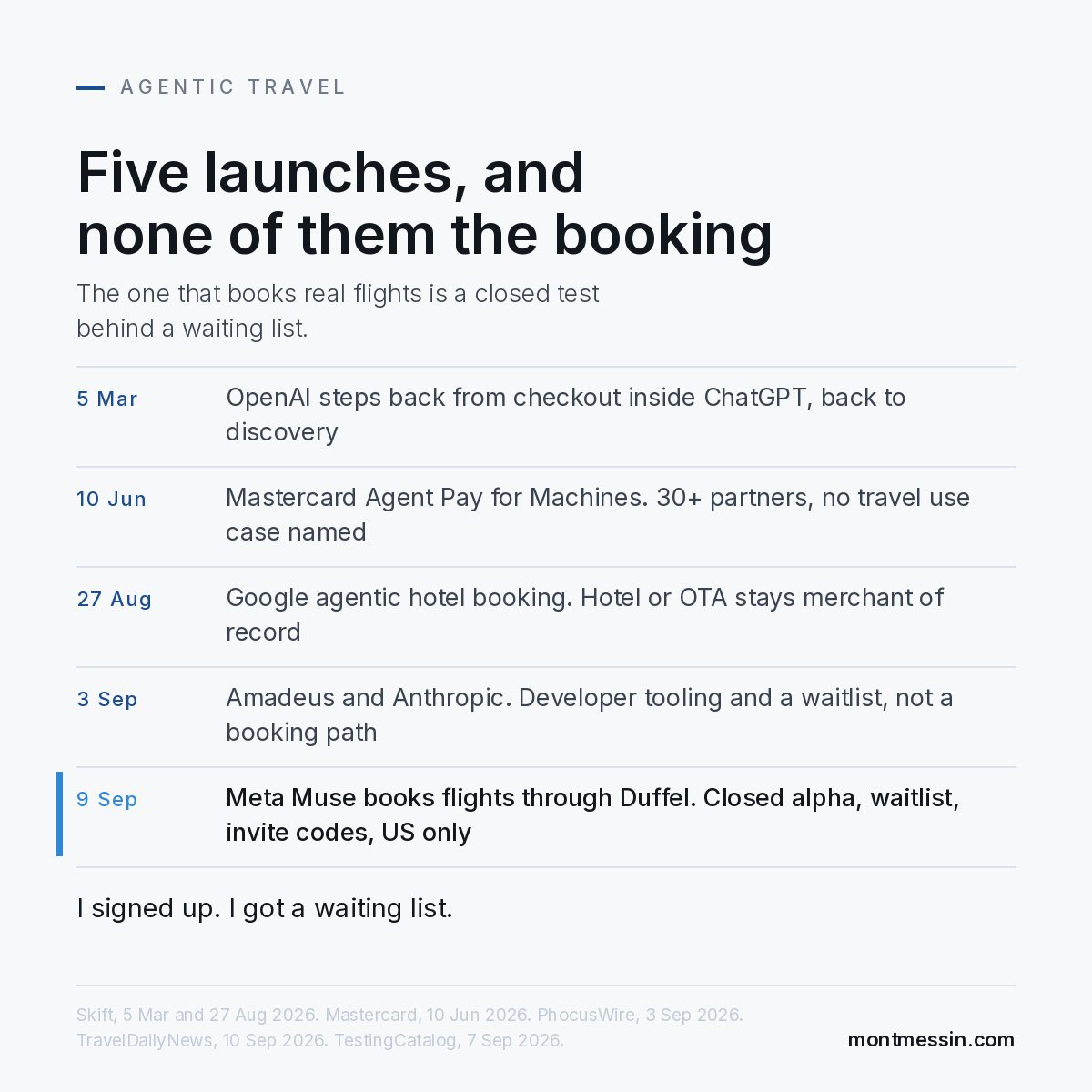
Put the five together and the same shape shows up in each. OpenAI pushed the transaction out. Mastercard's rails carry no travel use case yet. Google keeps the hotel or the OTA as merchant of record. The largest GDS's AI announcement is a better way to build against its content, not a way for an agent to book through it. And the one that does book is a closed alpha in one country.
Everything I can actually use this year sits next to the booking. Not the booking.
The one end to end agentic flight booking I can point to in production is a startup front end sitting on a legacy GDS and a legacy wallet.
So the infrastructure is arriving. The demand is slower.
That is not an argument for ignoring it. Instant booking on metasearch failed the first time too, and then became normal. Things in travel tend to arrive late and then all at once. My own feeling is that Muse is the closest thing yet, and that a waiting list in one country is still an announcement rather than a shipment.
But when someone tells me a distribution stack needs rebuilding this year for agents, I find myself asking three questions. Which agent. Booking what, against whose inventory. And who pays the chargeback when it books the wrong thing. The first two are the closing chapter of Airline Distribution Explained, on agents as a channel, and the third is the closing chapter of Travel Payments Explained, on what changes when the buyer is software.
The third one does not have an answer yet. Dispute rules assume two parties, a buyer and a seller. Here there are three, and the merchant is still the one paying the bank back. Muse does not change that, because Muse does not book anything. Duffel books. Whoever is merchant of record on that ticket carries the dispute, and I have not seen anyone say who that is.
If someone has seen that handled well somewhere, I would like to hear about it.
What I left out
Three things, and two of them are about numbers I decided not to use.
Some coverage of the Muse launch says more than five hundred airlines. Duffel's own site says three hundred plus, across NDC, GDS and low cost content, so I used Duffel's number. Airline counts in distribution are elastic anyway: direct connections, interline and ticketing partners all get added together and the total says less than it looks like it does.
The same coverage says the payment is made with a virtual card through Stripe. That would be interesting if it is right, because it would mean the agent is buying the ticket the way an agency does. But I could not find it confirmed by either Duffel or Stripe for the flight path, so I have left the mechanism out rather than build a paragraph on it.
And the line about everything sitting next to the booking is a statement about what I found and could use, not proof that nothing else exists. If something end to end shipped quietly, I would not necessarily have seen it. My one production example is a single company I happen to know, not a survey. It tells you the thing is possible. It does not tell you how common it is.
Added after publication, 16 September 2026
I ended this piece saying I had not seen anyone say who is merchant of record when an agent books a flight. Two people have since sent me screenshots of the Muse booking step, and they show more than I expected.
The agent does not have one booking path. It has two, and it asks the traveller to choose between them in a chat message. One is described as booking through Duffel. The other is the agent filling in the airline's own website on your behalf, airline by airline. The screen explains the difference in terms of convenience. The Duffel path is presented as usually the smoothest. The airline path is presented as giving you the airline's own confirmation flow.
Those two paths are not the same commercial arrangement. Different counterparty, different refund route, different place to raise a dispute. Nothing on that screen says so.
The same screen is honest about other things, which makes the omission stand out more. It warns that the trip books as separate tickets, each with its own confirmation and its own fare rules. It warns that if one leg sells out while another is being booked, you could end up holding a partial trip. And it says you approve one payment per ticket, so a four segment trip is several transactions rather than one.
I also read the Muse supplemental terms, dated 8 September 2026. They do not mention Duffel, or Stripe, or the words merchant of record, or flights at all. What they do say is precise about where the risk sits. The user bears all risk of financial loss arising from the use of Muse. The user is solely responsible for setting limits and safeguards, monitoring accounts, and disputing errors with the applicable financial institution or payment provider. And nothing in the terms creates an agency relationship between the user and Meta, or between Meta and any third party the agent deals with on the user's behalf.
So the document is silent on who the merchant is, and explicit on who carries the loss.
Two limits on all of this. I have not used Muse. It is United States only and I am still on the waiting list, so I am going on screenshots taken by two other people. And a screen naming Duffel as the booking path is not the same as a document naming Duffel as merchant of record. The card statement, or the booking confirmation, would settle it. If you have completed one of these bookings, I would like to know what yours says.
Sources
- OpenAI steps back from checkout inside ChatGPT, 5 March 2026: Skift
- Mastercard Agent Pay for Machines, 30+ partners, 10 June 2026: Mastercard
- Google agentic hotel booking in AI Mode, hotel or OTA remains merchant of record, 27 August 2026: Skift
- Amadeus and Anthropic, developer tooling rather than booking, waitlist open, 3 September 2026: PhocusWire
- Meta Muse and Duffel, flight search, booking and cancellations, 10 September 2026: TravelDailyNews
- Muse in closed alpha with a waitlist and invite codes, 7 September 2026: TestingCatalog
- Muse Supplemental Terms of Service, Meta Platforms, last updated 8 September 2026: Muse
- Duffel's own figure of 300+ airlines across NDC, GDS and LCC: Duffel
- No framework cleanly assigns chargeback liability between consumer, AI provider and merchant: Riskified, October 2025 and Chargeflow, July 2026